I keep saying that if I only wrote one paragraph per day, I'd write many papers (or one book) every year! And that just makes me realize that I don't really write one paragraph per day in anything, at least not in the mean. Bernhard Schölkopf (MPI-IS) helpfully (?) mentioned to me that this means that I write more in my blog than in all my scientific papers, combined. Whoops? Anyway, I caught up today and wrote many paragraphs, some in my paper about coordinate freedom and other symmetries, and some in my paper about not stacking your data.
Showing posts with label fundamental astronomy. Show all posts
Showing posts with label fundamental astronomy. Show all posts
2022-10-04


2022-08-14
spherical-harmonic transforms of point sets
On the weekend I computed the spherical-harmonic transform of Kate Storey-Fisher's quasar sample made from ESA Gaia data. I also computed the spherical-harmonic transform of the random catalog we use to map the selection function. The two transforms are extremely similar in their complex amplitudes! Since the random catalog is made assuming perfect homogeneity and isotropy, this similarity directly translates into a measurement of the isotropy of the Universe.

2022-08-08
do the stars make up a coordinate system?
Long, long ago, when I worked with Sam Roweis (deceased) and Dustin Lang (Perimeter) on locating images on the sky, we used to discuss coordinate systems: You don't actually need a long-lat or theta-phi coordinate system to describe the locations of things on the sky, right? You can just use angular relationships among sources to locate everything precisely and unambiguously! And with that approach, you don't need to make as many choices and standards and lines of code about reference frames. But, alas, this point of view is not in the ascendent.
Not being deterred, I put the bright stars on my maps (from this weekend) of Kate Storey-Fisher's ESA Gaia quasar sample. Can you find the big dipper and Orion? And Sirius?

2022-08-07
Lambert's projection
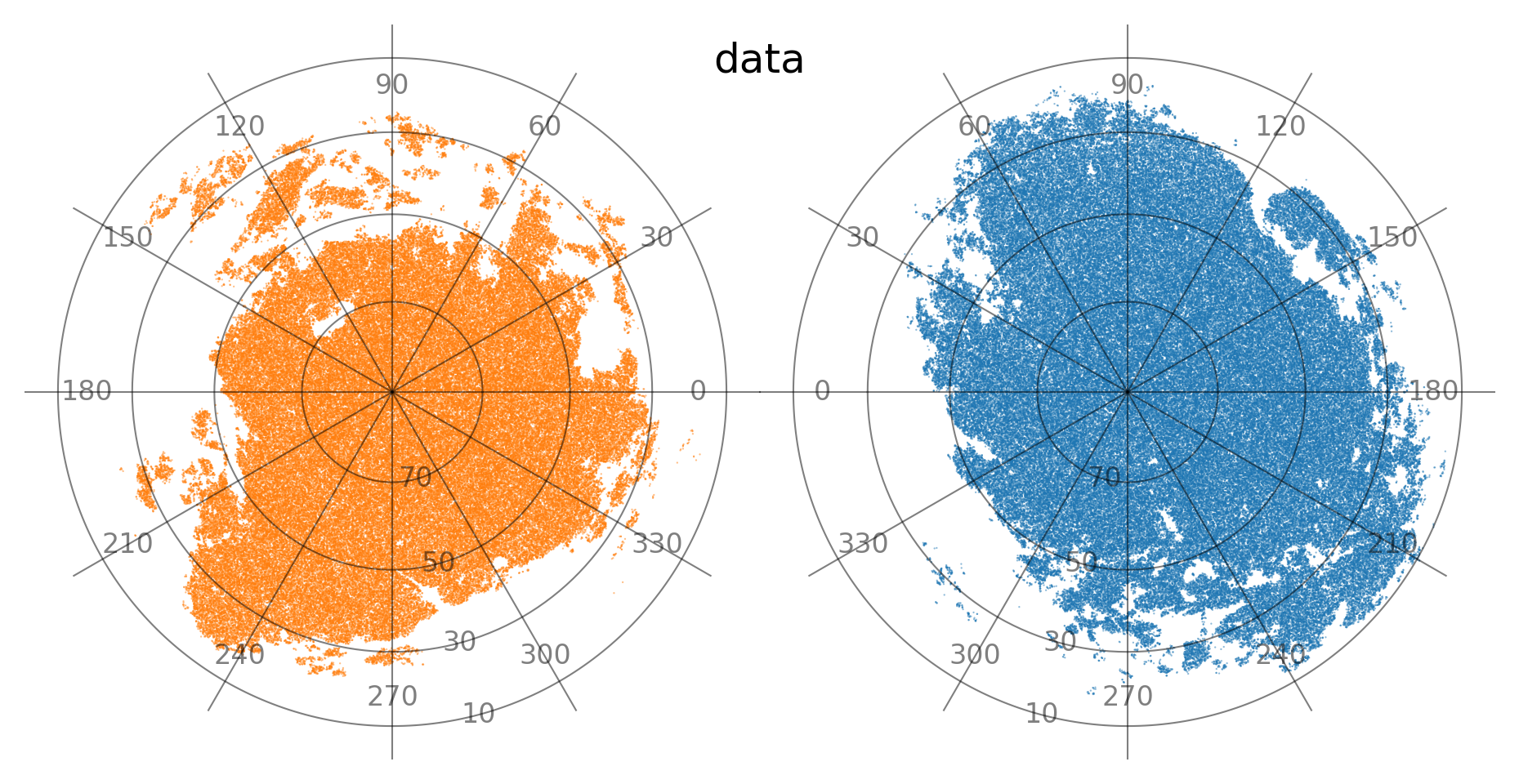
At the Heidelberg Tiergarten Schwimmbad I worked out the mathematics for an equal-area projection of the sphere, centered on the poles. It turns out that I reinvented Lambert's projection from the 1770s. Here's a plot of the Gaia DR3 quasar sample (censored by some dust cuts) in my new projection:
2022-03-12
what is a transmission function?
Mike Blanton (NYU) and I agree and disagree on almost everything about fundamental astronomy. As my loyal reader knows, I am writing something on how apparent magnitudes work, and also absolute, bolometric, reddening-corrected, and so on. The apparent magnitude of star depends (among other things) on a filter bandpass or a transmission function. There are two possible definitions of this. One is the fraction of light (as a function of wavelength or frequency) that makes it through the system, from the top of the atmosphere to stimulating the detector. The other is the mean contribution to the total counts read out by the detector of a photon (of a particular wavelength or frequency) impinging on the top of the atmosphere. These might sound similar—they are identical when your detector is a photon counter. But they aren't identical if your detector is, say, a bolometer. I struggled with how to simply communicate all this today.
2022-02-07
why do we still use magnitudes?
As my loyal reader knows, I am writing a piece on magnitudes, distance moduli, color indices, color excesses, bolometric corrections, and so on. Today I sent a copy of the draft to my excellent colleague Mike Blanton (NYU) for comments. He came back with lots! One of the main points he made is an elucidation of why (in his opinion) magnitudes make sense to be using even in this day and age: The physical quantities of interest about a (say) star are its bolometric or total luminosity, and its detailed (high-resolution) spectrum. The thing we can observe, photometrically, is neither of these. So we integrate photons in a bandpass. The magnitude system is a way of summarizing the choices we make when we do that, and reminds the theorist or interpreter that our measurements are complex integrals of the things of interest. That's a good argument. Prior to this feedback, my answer to the “why?” question was about precise relative measurement, which isn't so relevant in many contemporary contexts.
2022-01-20
the bolometric correction of Vega is not zero
Wow I went Inside Baseball (tm) today on magnitudes. Magnitudes were originally designed to be purely observational, purely relative measurements, relative to a standard star. But then once you go off-course and define absolute magnitudes (gasp) and then even farther off and define bolometric magnitudes (double gasp), the system is no longer relative to anything! It depends on (imprecise) distance estimates and (wrong) stellar models. So you get many absurdities, like that Vega is not zero in any Vega-relative absolute or bolometric magnitude system. I think maybe we've lost our way! And not because magnitudes are obtuse; apparent magnitudes and colors make lots of sense! We lost our way when we tried to extend this to cover luminosities of various kinds.
2022-01-18
why does anyone need a bolometric correction?
As I mentioned yesterday, and against my better judgement, I am writing a long pedagogical document on magnitudes and how they work. I got to the bolometric-correction part and I realized that I didn't understand exactly why they are defined and how they are used. So I had a long think. The answer is: Theoretical models of stars are better at predicting the total bolometric luminosity output (energy per time) coming from a star than they are at predicting the detailed spectrum. Thus it makes sense to separate the belief about the total luminosity from the belief about the luminosity in any one band.
2022-01-12
magnitudes are (logarithmic) ratios of signals
A couple of weeks ago I had intense arguments with Belokurov (Cambridge) and Farr (Stony Brook) about the definition of a photometric bandpass and a photometric magnitude. And a few months ago I had long conversations with Breivik (Flatiron) about the bolometric correction. For some reason these things took over my mind today and I couldn't stop myself from starting a short pedagogical note about how magnitudes are related to spectral energy distributions. It's not trivial! Indeed, the integral isn't the integral you naively think it might be, because most photometric systems count photons (they don't integrate energy). People often say that a magnitude is negative-2.5 times the log of a flux. But that's not right! It is negative-2.5 times the log of a ratio of signals measured in two experiments.
2021-05-13
re-parameterizing Kepler orbits
As many exoplaneteers know, parameterizing eccentric gravitational two-body orbits (ellipses or Kepler orbits) for inferences (MCMC sampling or, alternatively, likelihood optimizations) is not trivial. One non-triviality is that there are combinations of parameters that are very-nearly degenerate for certain kinds of observations. Another is that when the eccentricity gets near zero (as it does for many real systems), some of the orientation parameters become unconstrained (or unidentifiable or really non-existent). Today Adrian Price-Whelan (Flatiron) was hacking on this with the thought that the time or phase of maximum radial velocity (with respect to the observer) and the time or phase of minimum radial velocity could be used as a pair of parameters that give stable, well-defined combinations of phase, eccentricity, and ellipse orientation (when that exists). We spent an inordinate amount of time in the company of trig identities.
2021-03-16
what is a bolometric correction?
Today Katie Breivik (Flatiron) asked me some technical questions about the bolometric correction. It's related to the difference between a relative magnitude in a bandpass and the relative magnitude you would get if you were using a very (infinitely) broad-band bolometer. Relative magnitudes are good things (AB magnitudes, in contrast, are bad things, but that's for another post): They are relative fluxes between the target and a standard (usually Vega). If your target is hotter than Vega, and you choose a very blue bandpass, the bandpass magnitude of the star will be smaller (relatively brighter) than the bolometric magnitude. If you choose a very red bandpass, the bandpass magnitude will be larger (relatively fainter) than the bolometric magnitude. That's all very confusing.
And bolometric is a horrible concept, since most contemporary detectors are photon-counting and not bolometric (and yes, that matters: the infinitely-wide filter on a photon-counting device gives a different relative magnitude than the infinitely-wide filter on a bolometer). I referred Breivik to this horrifying paper for unpleasant details.
2018-12-12
actions, planet spectroscopy, dust
Discussions continued at Flatiron about Galactic dynamics and actions. We laid out uses for actions and then discussed more results from Beane (Flatiron) on the inconsistency of actions when you have wrong coordinate systems or potential.
Stars meeting featured various interesting discussions. But during a discussion led by Kreidberg (Harvard) about temperature-mapping hot rocky planets, I had an idea: We could use the strong absorption lines in stellar spectra to increase the planet-to-star brightness ratio. If we have full-phase coverage with high-resolution spectroscopy, we can look for the hot planet to “fill in” some of the absorption lines at full phases, and the amount it fills in for lines at different wavelengths would tell you the temperature (or low-resolution spectrum) of the planet! I want to do this with our HARPS data and our wobble pipeline!
In the afternoon, Boris Leistedt (NYU) and I made a plan with David Blei (Columbia) and Andrew Miller (Columbia) to build our 3-d dust model out of dust measurements. There are many problems to solve! But we are starting by assuming that Leistedt's data-driven dust measurements are correct and have Gaussian noise, the stellar positions are well known, and the dust field can be represented by a Gaussian process. In terms of challenges, we are starting by working on the scaling problem: How to make things run on millions or hundreds of millions of stars at a time? One dispute we had is about what line-of-sight integral of the dust corresponds to the extinction?
2017-08-30
#LennartFest day 1
I broke my own rules and left #AstroHackWeek to catch up with #LennartFest. The reason for the rule infraction is that the latter meeting is the retirement celebration of Lennart Lindegren (Lund) who is one of the true pioneers in astrometry, and especially astrometry in space and at scale. My loyal reader knows his influence on me!
Talks today were somewhat obscured by my travel exhaustion. But I learned some things! Francois Mignard (Côte d'Azur) gave a nice talk on the reference frame. He started with an argument that we need a frame. I agree that we want inertial proper motions, but I don't agree that they have to be on a coordinate grid. If there is one thing that contemporary physics teaches us it is that you don't need a coordinate system. But the work being done to validate the inertial-ness of the frame is heroic, and important.
Floor van Leewen (Cambridge) spoke about star clusters. He hypothesized—and then showed—that proper motions can be as informative about distance as parallaxes, especially for nearby clusters. This meshes with things Boris Leistedt (NYU) and I have been talking about, and I think we can lay down a solid probabilistic method for combining these kinds of information responsibly.
Letizia Capitanio (Paris) reminded us (I guess, but it was new to me) that the Gaia RVS instrument captures a diffuse interstellar band line. This opens up the possibility that we could do kinematic dust mapping with Gaia! She also showed some competitive dust maps based on Gaussian Process inferences.
2016-09-16
Gaia thinking
I continued to think about and write about Gaia DR1 projects today. In particular, I tried to write down a responsible way to measure the standardness of standard stars, given noisy parallaxes. I also tried to understand whether we have a scope and interesting-enough results on wide-separation binary stars to merit a paper.
2016-06-14
#ISBA2016, day two
Today was day two of ISBA, the big international Bayesian conference. In my session—which was on statistics in astronomy—I spoke about exoplanet search and population inferences (work with Foreman-Mackey, Wang, and Schölkopf), Xiao-Li Meng (Harvard) spoke about instrument calibration, and David van Dyk (ICL) spoke about Bayesian alternatives to p-values for physics and astronomy. Meng had very valuable things to say about taking an inference problem from the linear domain (where calibration multiplies linear flux) to the log domain (where log calibration adds to log flux). I learned a lot that is of relevance to things like self-calibration, where I think maybe we have been going to the log domain (very slightly) incorrectly! There is a half-sigma correction floating around!
van Dyk made the center of his presentation the five-sigma discovery of the Higgs Boson; he pointed out that five-sigma is very conservative in principle, but the fact that it has been applied to as many hypotheses as there are relatively different Higgs mass options makes it less conservative. This isn't trivial to deal with if the only question is whether or not there is a Higgs. He solved the problem in some Bayesian contexts and compared to frequentist multiple-hypothesis solutions. Interestingly, he isn't against using p-values in the discovery context (especially when billions of dollars of public money are at stake); 5-sigma p-values are conservative, and (more importantly) perceived to be conservative!
2016-03-10
my heroes at Cornell
I gave the MacConochie lecture at Cornell Astronomy today. I spoke about The Cannon. At the start of my talk, I thanked Tom Loredo (Cornell) for starting the consideration of principled inference in astronomy that has been so ascendent (and so influential in my own work), and Paul Ginsparg (Cornell) for starting the arXiv, which may be the most important development in physics in my lifetime! I had the pleasure of dinner with Loredo and will meet Ginsparg tomorrow.
In my day of meeting with people, the most fun was had with the graduate students, who fed me pizza and talked about their work. The range of activities is extremely wide at Cornell, with a range from the high-redshift universe to near-Earth asteroids. I raised the question: Is radar ranging of asteroids really “astronomy”? The reason I ask is: It is not a passive collection of photons (or cosmic rays or neutrinos or gravitational waves); it is an actively controlled scattering experiment!
2015-01-16
light echos in LSST
Fed Bianco (NYU) gave a great talk today about eta Carinae and light echos, mass loss, and the progenitors of stripped supernovae. Amazing stuff, especially the light echos. One thing the whole audience was excited about was the idea that if you had truly high-quality synoptic imaging like LSST will provide, you might be able to do some amazing simultaneous modeling of the dust (the reflector) and time-variable point sources (the radiation field). My intuition that this "blind deconvolution" problem could be solved is based on the facts that (a) the radiation source is a very sparse set of point sources and (b) the dust lies in a (fairly) continuous, (fairly) isotropic distribution, while the light echo geometry is the surface of an expanding anisotropic ellipsoid. I bet that one isn't in the LSST Project Book.
In the afternoon, I spoke with Vakili about a possible huge speed-up in Cramer-Rao-saturating point-source centroiding methods, and I spoke with Huppenkothen about gamma-ray bursts in the Fermi data. On the latter, she is planning on putting in a data analysis proposal which would develop further our "Magnetron" project for modeling bursty bursts.
2014-12-09
dotastronomy, day 2
Today was the Hack Day at dotastronomy. An incredible number of pitches started the day. I pitched using webcam images (behind a fisheye lens) from the Liverpool telescope on the Canary Islands to measure the sidereal day, the aberration of starlight, and maybe even things like precession and nutation of the equinoxes.
I spent much of the day discussing and commenting on other hacks: I helped a tiny bit with Angus and Foreman-Mackey's hack to sonify Kepler data, I listened to Jonathan Fay (Microsoft) as he complained about the (undocumented, confusing) Astrometry.net API, and I discussed testing environments for science with Arfon Smith (github) and Foreman-Mackey and others.
Very late in the evening, I decided to get serious on the webcam stuff. There is an image every minute from the camera and yet I found that I was able to measure sidereal time differences to better than a second, in any pair of images. Therefore, I think I have abundant precision and signal-to-noise to make this hack work. I went to bed having satisfied myself that I can determine the sidereal period, which is equivalent to figuring out from one day's rotation how many days there are in the year. Although I measured the sidereal day to nearly one part in 100,000, my result is equivalent to a within-a-single-day estimate for the length of the year of 366.6 days. If I use more than one image pair, or span more than one day in time, I will do far, far better on this!
2014-07-14
centroiding and searching
I spoke with Vakili about centroiding stars. We are trying to finally complete a project started by Bovy ages ago to compare the best-possible centroiding of stars with a three-by-three pixel hack related to what is done in the SDSS pipelines. Vakili hit this issue because if you don't have good centroids, you can't get a good point-spread function model. Well, actually I shouldn't say "can't", because you can but then you need to make the centroids a part of the model that you learn along with the point-spread function. That may still happen, but along the way we are going to write up an analysis of the hack and also the Right Thing To Do.
Foreman-Mackey, Fadely, Hattori, and I discussed Hattori's search for exoplanets in the Kepler data. The idea is to build up a simple system based on simple components and then swap in more sophisticated components as we need them. We discussed a bit the question of "search scalar"—that is, what we compute as our objective function in the search. There is a likelihood function involved, but, as we often say in #CampHogg: Probabilistic inference is good at giving you probabilities; it doesn't tell you what to do. Search is a decision problem.
2014-07-04
web cams and James Bradley
Over lunch, Markus Pössel (MPIA) mentioned that he can measure the sidereal day very accurately, using a fish-eye or wide-field web cam pointed at the sky. This led us to a discussion of whether it would be possible to repeat Bradley's experiments of the 1700s that measured stellar aberration, precession of the Earth's axis, and nutation. Pössel had the very nice realization that you don't have to specifically identify any individual stars in any images to do this experiment; you can just do cross-correlations of multi-pixel time series. That's brilliant! We decided to discuss again later this month along with a possible (high school) student researcher.
Before that, Roberto Decarli (MPIA) and I discussed various projects. The most interesting is whether or how you can "stack data" (combine information from many images or many parts of an image) but in interferometric imaging data. Decarli has shown that you can do this stacking in the fourier space rather than in the image space. That's excellent, because the noise properties of the data are (conceivably) known there, but never understood properly in the image space. I gave him my usual advice, which is to replace the stacking with some kind of linear fit or regression: Stacking in bins is like linear fitting but under hard assumptions about the noise model and properties of the sources. We agreed to test some ideas.
Subscribe to:
Posts (Atom)